Food and the Kingdom of God

1 Comment

Gluten-free, slow foods, farm-to-table, organic, paleo, real food, vegan – who knows HOW or WHAT to eat anymore!

The Table Comes First

I just finished reading a compelling book The Table Comes First.  Adam Gopnik explores the history and philosophy of meals and restaurants.   At the end, however, he reveals that he belongs to that segment of the population who doesn’t worship God.  Therefore, in lieu of the salvation paradigm of Christianity, he makes the assertion that the elevation of the pleasures of dining and sharing a meal can provide meaning, purpose, depth and a sort of rescue to otherwise unmoored humans.

If I look at my own idolizing of ways of eating, I also plead guilty to seeking ‘salvation’ through food.  But with Gopnik’s bold claim, I was struck by how unnecessary it is to place food and Christianity into opposite camps.

Consider the following tangible examples:

  1. Human history originates in a garden with an abundance of fruitful trees for the sustenance and pleasure of God’s image-bearers.  The other bookend of the Bible and the human story are set as a heavenly feast with the host of the Party Himself!
  2. The resurrected Jesus asked for a piece of broiled fish to eat. (Luke 24: 41-42)
  3. A fair number of Jesus’ signs and miracles produced, transformed or multiplied food and drink.  Think of the wedding at Cana and the fine wine.  And the two accounts of the feeding of the 5000.  And manna and quail for the wandering Jews in the desert, accompanied by water from a rock.
  4. Honey revived King Saul’s son Jonathan after a long battle. (1 Sam 14:27)
  5. Gleaning in the barley fields led to Ruth’s marriage, the great-great grandma of King David from whose line Jesus came.
  6. Jesus dined with women and the marginalized segments of society, to the shock of the elite and rule-following average Hebrew.
  7. And let’s not forget the setting for the inaugural New Covenant of Grace, a Passover meal.

And if the above are examples of material food and drink, then there are all the image passages that point beyond food qua food:

  1. We are commanded to, “Taste and see that the Lord is good.” (Ps 34:8)
  2. Jesus likened himself to the staff of life. “I am the bread of life.” (John 6:35)
  3. Paul himself chose covenantal wine to symbolize his final days when writing to encourage Timothy – “For I am already being poured out as a drink offering, and the time of my departure has come.” (2 Tim 4:6)

What good news that we don’t have to choose either secular society’s view of food and drink or an ascetic version of Christianity!

My husband reminded me last night of one of CS Lewis’ main teachings about human desires.  These ‘hungers’ are NOT ends in themselves, but signposts to something greater that can only be satisfied in a better and deeper way.  So if we find that we are hungry for earthly food, then we were created for a more satisfying food that will be provided us upon receipt of our inheritance.  The desires ARE real and they WILL BE fulfilled, but in ways that we cannot begin to imagine.

My take away in thinking this through is to be BETTER prepared when describing true Christianity the way it really is to a world jaded and blasé about life.  This world doesn’t satisfy.  And it never was MEANT to.

Recall the excitement you might once have lived when you were very little and Mom and Dad treated you to one of your first outings for lunch or an ice-cream.  Or think back to one of your initial dining experiences as a young adult on a date in a fancy restaurant. The way they thrilled you can never be quite the same.

But Christians don’t have to be wearied with this present world.  The best truly IS yet to be.  We won’t miss out by being a Christian.  We get it all with Christ.

Bon appétit!

Bon appétit

Why we run away from trials and suffering and why we shouldn’t

Leave a comment

I know, O LORD, that your rules are righteous,
and that in faithfulness you have afflicted me. Psalm 119:75

Seems that every other archived sermon I listen from my iTunes feed of daily John Piper ‘past sermons’ is about suffering and the benefits.  But he’s not the only one proclaiming that uncomfortable message.  Another pastor Mike and I follow has started a series on the Book of James, written by Jesus’ half-brother.  You know how he starts at the beginning of his letter, that invitation to join the ‘Pure Joy Club’?

Count it pure or all joy, my brothers when you fall into trials of many kinds….

And then there is my hero in the faith, George Mueller, the 19th century British pastor who prayed about the idea, then planned for and ran orphanages that eventually housed 3000 parent-less children over 40-50 years.  Not once did he publish outside of the handful of praying partners the financial needs to support what he undertook.  And God directed daily bread (literally and also metaphorically, referring to all their needs) Mueller’s way.

But it was not easy. Most often the forthcoming provision was obscured until the last minute.  After decades of practice at banking on the Father to meet all their needs, Mueller concluded that the good and ever-present God:

  • gives us problems and difficulties, so that we are led to exercise prayer and faith and grow stronger

Yet, we’re human.  It’s a no-brainer to choose comfort and ease and visible provision.  But could we be wrong in what we cherish, in what we think is due us, what we conclude will best serve us?

One doesn’t have to look far to see that whereas EVERYONE suffers in life, the pain and problems are disproportionately distributed. Does that seem fair to you?

No!, but…..caveat coming:  Pursuing that question of ‘rightness’, going down THAT path will NOT lead to any SATISFYING answer that quiets all our questions. Just ask Job.

So of course the uneven assigning of pain doesn’t seem fair.  But don’t let us therefore conclude that God is neither in charge NOR good.

Yes, the world is messed up.  And always has been since our primal parents opted for their own wisdom, rather than God’s.

But that doesn’t mean that suffering and problems are gratuitous.

Here’s what one language scholar from Blue Letter Bible wrote in explaining the word ‘afflicted’

  • Jehovah depressed/ consumed my strength that was in the way

Why would God do that?  Well, plenty of Bible contributors have explained that:

  • Before you made me suffer, I used to wander off, but now I hold on to your word. Ps 119:67
  • My ears had heard of you but now my eyes have seen you. Therefore I despise myself and repent in dust and ashes. Job 42:6
  • God opposes the proud, but gives grace to the humble. James 4:6

Looking at that last verse snippet, let’s ask this question: To whom does God give His supernatural power and wisdom and favor?  only to the humble.  How does God humble us?  Well, you tell me!

Okay, so this makes sense on paper.  What about LIFE?

In this current season in my late 50s, what I struggle with is still….. willling and eager worship of my self-created version of ‘feeling good’.

And it seems that the more lessons He plans for me, the worse my situation, my sin grows. It happens in 3 ways:

  • I understand more clearly the evil of idolatry
  • I feel more helpless to deal with it
  • I cling to it all the more

As Paul bluntly cried out to his scribe, (and I paraphrase) Miserable, self-absorbed wretch that I am, who can rescue me from this mess?  Romans 7:24

I know everyone can identify when they think of that one (at LEAST one) on-going, dogged sin that we both despise and cherish in some sick way because it’s familiar.

Permit me to share some hope that I recently received during an episode of God’s ‘attentiveness’:

  • First – from Blue Letter Bible, again about the term ‘affliction’

The simple basic verb ‘to be afflicted’ means ‘occupied with/ busied with.  So when we are blind-sided with suffering, whether brought on BY ourselves or BY another, God is at work in us, concentrating ON us.

So we can’t say, “Where is God???!!!!”  He absolutely IS with us, is busying Himself with us.

  • Second – in a sermon Pastor Steve Brown entitled, ‘Don’t Waste Your Sin’, I learned something new.  When Jesus died on the cross with our sins attributed to or assigned to Him, He paid for them, right?  A synonym for ‘paid for’ is ‘purchased’.  Jesus BOUGHT our sins for us, so in one sense, we ‘own’ them. Brown counsels us to put them (the cancelled sins) to constructive use.  What does he mean?  Think of the woman at the well who, once she was saved, happily and boldly proclaimed to her fellow villagers, “This man told me ALL about myself!”  And she was joyful.  She made GOOD use of her sins, that SHE committed, that she chose time and time again, but that Jesus had forgiven.

So, if I apply those ideas to myself, then each time (and there will be more, I don’t doubt) I struggle with investing importance in my particular ‘something’, which is created, rather than the creator I hope I remember:

God is doing something ON me for my good.

Jesus bought this sin, so how can I use it to bless someone else?

For starters, no point in covering it up!  May I boldly share how God never tires of restructuring the same ole’/same ole’ lesson to conform me to His Son. And if He keeps forgiving AND using even THIS stupid sin in my life, then He will do the same for you!

The blahs or joy-less-ness

Leave a comment

Psalm 51:7–12 “Purge me with hyssop, and I shall be clean; wash me, and I shall be whiter than snow. Make me hear joy and gladness, that the bones You have broken may rejoice.  Hide Your face from my sins, and blot out all my iniquities. Create in me a clean heart, O God, and renew a steadfast spirit within me. Do not cast me away from Your presence, and do not take Your Holy Spirit from me.  Restore to me the joy of Your salvation, and uphold me by Your generous Spirit.”

By God’s gifting, I am more a joy-filled gal than not. I wasn’t always so, but as I have come to know more and more the Biblical God, I have grown happier.  Multiple events each day cause me to look forward to getting up.  But occasionally, God blesses me with a short period of the ‘blahs’.  My dad used to say he had lost his ‘perk’.  He meant physical energy to move about, but I apply the same principle to the state of my emotions.  I say this is a gift, because feeling like there is NOTHING that excites me connects me to those I love who live in that place more time than not.  My empathy grows as a result.

depressed Snoopy

I’m not sure what prompted this recent attack of the blahs, but they came on last Thursday and lasted through Friday. Nothing appealed.  Nothing beckoned.  I felt bored and in that state of mind, I could see no change on the horizon.  I know, it sounds dramatic, doesn’t it?  And pathetic!  That’s what emotions do; they cloud our reasoning.

Knowing WHAT to do, I started preaching to myself, on my commute home from school, instead of listening to myself as many advice.  Truths about my identity in Christ; facts about God’s character; my treasure awaiting me in heaven….everything that I knew to be true.  None of that seemed to lift the mood.

But ‘out of the blue’ came a new thought: “The best is yet to be!” That’s a line either from a poem or a song but those 6 words actually express a truth taught throughout the Bible.  I took it and ran – in logical fashion:

  • If we live in a fallen world and are flawed people…..
  • If one of the consequences of the fall is painful labor…..
  • If God gives not only faith in Himself but suffering as gifts (for it is granted to you to believe and to suffer in Christ – Phil 1:29….)
  • AND if in the presence of God, there is fullness of joy and pleasures evermore (Ps 16:11)…..

Then….I don’t have to expect that I will experience fullness of joy HERE and NOW!!

It’s so easy to self-medicate to erase the joylessness.  Numerous times have I turned either to food or to purchases or to withdrawing into my world of books.  But if periods of joylessness are to be expected, then there is nothing that needs remedying.

Those thoughts in themselves were liberating.  “Well no wonder that I experience some of the blahs….true full joy is promised later!  I can wait,” rang this fresh understanding.

After a sigh of relief, my rescued thoughts (still in the car) turned to the possibility of calling ‘so-and-so’ and catching up with her.  I reached her and sealed my renewed thinking by getting my mind off myself, a comfort.  By the time I reached home, I had forgotten that I was feeling blah.

Okay, I can hear you say, “Well, bully for her!  My condition is chronic. I seem to have been born melancholic by temperament.”  I recognize that compared to you, I don’t even know what suffering is. And my heart goes out to you. I think after these 2 days becoming familiarized once again with what you awaken to daily, I can better understand your struggle.

Here are my two cents’ worth of advice, for what you can glean from it:

  • DO NOT beat up on yourself.  You are not being a bad Christian.  Soak in the fact that the Father loves you and chose you IN THIS STATE, if melancholy is your natural bent.
  • DO take care of yourself physically and keep up the habits of Bible-reading and prayer, especially when you don’t feel like it!

I bring up prayer because David models for us a Godly man who experienced periods of the blahs or joylessness.  Why would he ASK God to restore to him the joy of his initial salvation, if he were not missing it?  And look how he frames that request?  Make me to HEAR all about true joy and gladness.  Initial and on-going hope and assurance, i.e. FAITH, come from hearing the Word. But if we are talking to ourselves about how flat we feel, then we can’t give any attention to facts contrary to our feeling.

So prayer which arises from within Bible reading is life-rejuvenating.  In fact, the two most encouraging words I know from Scripture are:  But God!

He is the unpredictable (at times) God who does more than we can ask or imagine.  Those 2 words happen to pop up in numerous passages, but I’ll leave one to encourage you.
My flesh and my heart may fail, but God is the strength of my heart and my portion forever.  Psalm 73:26

Does God need anything?

Leave a comment

Yes, He does. He needs our weakness!

Checkbook of Grace

But he said to me, “My grace is sufficient for you, for my power is made perfect in weakness.” Therefore I will boast all the more gladly of my weaknesses, so that the power of Christ may rest upon me2 Cor 12:9

What an amazing and imbalanced swap!  We give God our weaknesses and in exchange, He provides His unlimited power and strength.

In Paul’s case, God did not remove the illness or disease (that ambiguous thorn in his side), but gave Paul endurance not only to bear it but to rejoice in it.

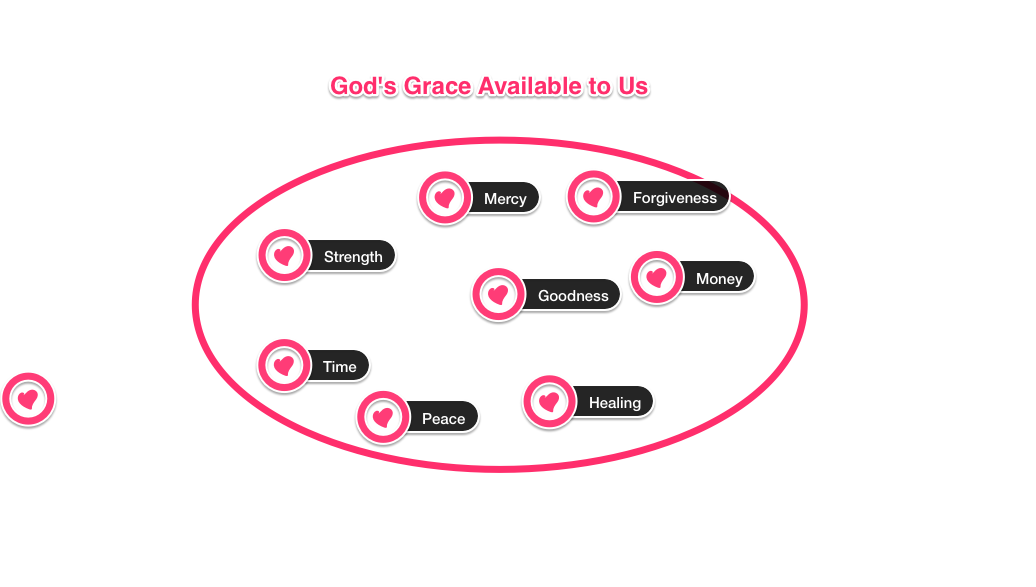
I’ve been thinking about 3 things – ‘boasting in weakness’ as Paul puts it, God’s provisions and my needs.  John Piper writes in his book Faith in Future Grace that most of God’s word to us is in the form of promises.  It’s like God hands his redeemed kids an unlimited checkbook called Grace.   If grace is the set of all of God’s gifts to us, then within that purse or checking account or cupboard (whatever metaphor you prefer) are coins/checks/containers of different resources.

God's Grace Venn Diagram  You probably can’t read the small titles, but I think you’ll get the idea.  The big circle is all the grace available to us; the points are names of the forms of provision like:

  • mercy
  • strength
  • forgiveness
  • peace
  • financial resources
  • time
  • healing
  • patience
  • understanding
  • faith
  • rescue

The promises become precious to you and me only when we are desperate and bank our all on them, moving out of the paralysis of fear into the open space called ‘trusting God to do what He says’.  Hence the checkbook.  Some of us carry a checkbook around in a pocket or purse and when we need something and don’t have the money in hand, we write a check and count on both the merchant accepting it in lieu of cash and our bank honoring it.

It’d be stupid to continue to be needy all the while carrying a valid checkbook!  But that is how we act with God’s word.

Okay – so here is where this gets real for me.  What is my # 1 weakness?  It’s the continual fear that I won’t have ENOUGH TIME to do what I need to do for school and home AND……have some time left over for me to do what Maria wants.  Daily and hourly I face and fight that fear.  So God, in His kind design to wean me off my fear and grow my default mechanism to trust Him continually, SEEMS to give me more stuff to do than I can SEE time available to me.

I’m a slow learner.  But I’m getting better.  My thoughts are lining up more times than not (80%) with God’s word. My heart, however, still drags its feet.

To help both you and me, here are some encouraging words.  Take them as reasons to believe that these promises ARE indeed meant to be used.  The first one states the fact that we actually POSSESS these promises if we are indeed Children of God:

  • (Paul lists several promises and ends a chapter quoting a promise from the Old Testament in 2 Sam 7:14 ) “I will be a Father to you, and you will be my sons and daughters, says the Lord Almighty.” (Paul then reasons…) Therefore, since we have these promises, dear friends…... 2 Cor 6:18 – 7:1a   

  • But my God shall supply all your needs according to his riches in glory by Christ Jesus – Phil 4:19
  • For I can do everything through Christ, who gives me strength – Phil 4:13
  • I am the Lord your God, who brought you up out of Egypt.  Open wide your mouth and I will fill it – Psalm 81:1

There are hundreds and hundreds of promises that will stun you if you will accept them as truthful words from a reliable source.

But how can we really know that God will come through and the check not bounce? I’ll leave you with two realities that reassure me:

  1. All I have to do is look back over my past (recent and long ago) and see the many ways He has come through when I both relied on Him and doubted Him. (call that “mercy and kindness added to provision”).
  2. The definition of God is composed of His attributes.  So when you consider just ONE characteristic –  ‘faithfulness to His word’, if anyone could top God then that person would be God.  The very definition of ‘God’ means that no thing or no one tops Him in  ANY and ALL of these qualities.  So we can reason and relax that when it comes to doing what He pronounces He will do, then He WILL do it!

So tell me, which promise of God is most precious to you?  What is your # 1 ‘go-to’ pronouncement of provision in this season of your life?  I’m composing my own ABC list of promises that I can have at my disposal and I’d love to be reminded of other treasures in the Bible.

Can we really trust God?

2 Comments

George Mueller   George Mueller is my hero in the faith. He’s the pastor who together with his wife undertook orphan care in 19th century England. His primary purpose was NOT to provide love, care and education for children, BUT was to collect evidence to share with ordinary Christians that God had NOT changed and could still be trusted. In his words, Mueller wrote in 1835:

  • “….so many believers with whom I became acquainted were harassed and distressed in mind, or brought guilt on their consciences, on account of NOT trusting in the Lord: (these) were used by God to awaken in my heart the desire of setting before the church at large, and before the world, a proof that He has not in the least changed; and this seemed to me best done, by the establishing of an Orphan-House.”

Two features stand out about this adventure in trusting God:

  1. Mueller NEVER asked for funds.  He and his wife and the matron who worked with them prayed the money in, by taking God at His Word, by banking their all on His promises to provide.
  2. When all was said and done by 1870, 1722 children were being taken care of in 5 purpose-built homes that had required 100,000 English pounds to build, all provided by God through unsolicited donations.

So…the other dark day, in the midst of despairing over my own particular sin ‘bent’ that was overcoming any joy in the Lord, it came to me (thank you for your prayers used by the Holy Spirit, dear friend!) to tackle it once more but BY FAITH in God’s promises rather than by determination and Maria-power.  (yes, a novel idea, you rightly smirk!)

I’m embarrassed to share that this struggle with sin revolves around eating and my weight and the pre-eminent place all that still holds in my heart. The fight against idols persists. But the truth is my weight has gone up AND (creating the unpleasant dilemma) I like to eat. Reflecting soberly about this situation for the umpteenth time, I moved cautiously in the following direction.  So as not to change the kind of healthy foods nor the PORTIONS of the 3 meals I eat,  I settled on cutting out snacks between meals, a small change I know.  The daily deficit would be about 300 calories.

The next step after setting on a plan was this: I named my fears in black type on the white screen in an on-line journal:

  • That with such an incremental approach, I’ll just kind of ‘forget’ I’m doing this and go back to my old way of eating. I’m an expert at rationalizing and changing my mind.
  • That I will be hungry and unsatisfied between meals and feel sorry for myself and won’t be able to stand those feelings.

I knew I needed a go-to verse as my first weapon, if I was going to undertake this adventure in Holy Spirit power.  So I cobbled together 2 verses that quickly came to mind:

When I am afraid, I will put my trust in you, the God who is able to do IMMEASURABLY more than all I can ask or imagine, according to Your power that is at work in me! Ps 56:3 and Eph 3:20

My husband has often shared with me his joined-at-the-hip pair of verses that he prayed for our son Wes to lean on as he underwent the rigors of Ranger School:

Apart from you I can do nothing; but I can do all things through Christ who strengthens me!  John 15:5c and Phil 4:13

So yesterday, day 1, we walked in the rain, it being a Saturday and NOT a hiking day.  I knew that given our leisurely start, I would not be able to eat my packed lunch until we reached the turn-around point of our walk at Biltmore Estate. As I anticipated being hungry and not having my habitual baggie of almonds to snack on, I leaned on God’s promise of provision.

152 - Biltmore in the rain on 10 Oct 2015

I took that fear and looked past it to God’s promise to provide in ways I can’t even project.

And He did!  No surprise there.

We ate lightly for supper, as I tried a new recipe for wild-caught flounder.  But again I contented myself with the assurance that each time I started to ‘panic’ I could take comfort in the God who IS living and runs the abundantly full cupboards of grace set aside for each of His children.

Day 1 – victory in Christ and on to adding to God’s track record of proof.  I know that He can be trusted.  I just need to prove it to myself again in that dark place that has been my hold-out, a stronghold of self-control and sin.

Are you exhausted?

7 Comments

God helps those...

Have you ever heard this American-ism?  Who hasn’t?  In fact, my father used to quote it to me all the time growing up.  Trouble is, he wasn’t a Christian.  But he was a self-made man.  He grew up in a family that had money, pre-1929!  Born in 1924, he lived a while in Alaska as his family raised silver blue foxes for their fur-fashioned luxury stoles and coats supplied to wealthy blue bloods.

Silver Fox Fur Jacket

That niche soured quickly as the depression dried up the demand for expensive accessories.  Reduced to poverty, the family moved south to Arizona where his father was killed by a drunk driver in 1930.  ‘Mom’ relocated back to Arkansas with my dad and two brothers to eke out a living. There were cousins there, I think. The family scraped by, subsisting at the lowest economic rung. FDR saved my dad through innovative Civilian Conservation Corps camps for young men.  Spending his senior year of high school away from home, Pop studied at night in order to graduate on time with his class back in Mountainburg, Arkansas. His checks provided the funds so his mom and youngest brother could eat.  From there my dad joined the army, grappling his way up the military ladder. He earned a BS and an MA at night. He commanded units in Korea and Viet Nam during 5 combat tours. He pioneered and wrote aviation doctrine as well as a book.

About his relationship with God, all he would ever say when I gently pressed amounted to: “I’ve made my peace with the Lord” But my dad DID live by the ‘Gospel’ – the American good news of ‘work hard and make something of yourself’.

And Ben Franklin’s aphorism about God lending a hand to independent self-helpers fit his worldview. See this brief Wikipedia explanation of the history of the phrase that Ben Franklin popularized. For a long time I didn’t know how to counter that statement.  After all, the Bible does extol working hard to add to our virtue.   Take Peter’s exhortation in 2 Peter: 1:5-7

For this very reason, make every effort to add to your faith excellence, to excellence, knowledge; to knowledge, self-control; to self-control, perseverance; to perseverance, godliness; to godliness, brotherly affection; to brotherly affection, unselfish love.

That sounds like effort!  If the God-waiting-on-us-to-do-our-part doctrine is not so, then what do we make of much of the moral law in the Bible?

After thinking about how to reconcile “work hard and your efforts will be supplemented by God v. to trust God and watch Him do it all” I think I can propose the right way to consider this topic.  Here’s my attempt:

It’s a matter of one’s starting point, having the correct ‘mindset’ to borrow a term in vogue in my field of education. Do we believe that God created us and then left us to follow our interests and passions, with our calling the shots in life?  Or do we take our cue from our Creator and ask some of those foundational questions such as:

  • Since God created us, He must have had a purpose. What might that be?
  • And if it makes sense to look at what He has written to discover His plans for us, what has He said?
  • And how are we to DO this work for Him?

It would also be prudent to identify God’s own ‘teleos’, His goal for offspring created in His image. Fortunately, He does not leave us guessing.  God writes in Isaiah 43:6b-7:

Bring my sons from afar

and my daughters from the ends of the earth—

everyone who is called by my name,

whom I created for my glory,

whom I formed and made.

Paul in the New Testament echoes the same purpose when he writes to the Christians in Ephesus: (Chapter 2:10)

For we are God’s handiwork, created in Christ Jesus to do good works, which God prepared in advance for us to do.

Here’s the  64 thousand dollar Q

How does God get the glory when the spotlight shines on us and what WE do…..with a little boost from God?

That was rhetorical, obviously.  He can’t!

God ONLY gets the praise and glory and acclaim He deserves when unlikely, weak people accomplish His work where it’s evident that only He could have enabled either the attitude of the ‘worker’ or the results. Remember the 5 loaves and 2 fish accounts?  Were the disciples praised for their supply of enough food to satisfy 5000 hungry men? Do you understand a bit more Jesus’ curious exhortation:  Let your light so shine before men that they see your good works and glorify your Father who is in heaven.  Matthew 5:16

I never could figure that out!  If we’re doing the good works, wouldn’t WE get the kudos? Why would anyone think to praise God?

Good question!

The good deeds we are to do, we are to do with His strength, in a humble way that magnifies the surpassing greatness of God. No surprise there!  If we actually read His Word, we find out that God expects nothing less from us. After all He explicitly created us to carry out and accomplish pre-planned tasks, each one initiated BY HIM for you and for me.

So back to my blog title: Are you exhausted?  Could it be that you are doing a lot of ‘good stuff’ that you initiated without reference to Your Creator?  And working hard in your own strength, in a way that makes you look good?  No one is denying that much good is done in the world by Christians and non-Christians alike.  But IF we’re worn out, maybe, just maybe it might be because we are functionally living out the American Credo.  After all, who could possibly criticize our good works? Have you considered the answer to that question might be God, Himself?

Here’s a sobering thought: …..anything that is not done in faith is sin.  Romans 14:23c

Is worry normal or is it a sin?

1 Comment

Worry

Yes!

Yes, anxiety is normal and yes, practicing anxiety is a sin.

And there is good news.

I’m being trained to look behind a statement in scripture to reason about the condition of the author.  For example, yesterday morning I paused at verse 4 while reading Psalm 86:

  • Gladden the soul of your servant, for to you, O Lord, do I lift up my soul.

Since it was a rainy, gloomy Saturday morning I immediately asked God to gladden both my and my husband’s hearts.  But afterwards I realized that the only reason the Psalmist would have penned such a request was because he was struggling with the blahs or worse and knew he could count on God to help him!  Why ask for something of which you have no need????

Here’s another verse from Matthew 6:25

  • I tell you, do not worry about your life, what you will eat or drink; or about your body, what you will wear.

Why would Jesus dedicate these minutes to expound on worry if He didn’t SEE or KNOW that worry was present in the hearts and minds of those listening to Him?

How about the command NOT to fear?  I read in the on-line Christian Post (5 Nov 2014 blog post entitled Faith over Fear) that Jesus’ primary teaching was: to love others. (125 times taught in the Gospels) According to the writer of the post, Jesus presented and organized His teachings by theme.  And the primary theme (21 times) for His instruction was about FEAR.  Do not fear; don’t be afraid; be courageous; be firm in your faith.  This means that Jesus exhorts us to LOVE by NOT FEARING.  Hmmm, could it be that fear drives out love?  Is that the reason that the apostle John pens in 1 John 4:18?:

  • There is no fear in love. But perfect love drives out fear,

And why would Jesus repeat such a message if it weren’t a glaring problem?

So YES – worry and anxiety are normal, but they are neither GOOD, nor HEALTHY, nor appropriate for Christians.  In fact, worrying is a sin since God commands us NOT to worry.

So how does it help to know that worry is both a sin AND a normal reflex?

Because God doesn’t leave us to battle it on our own. There is supernatural power to fight sin.  And we are called to enter into warfare every day of the Christian life. Through daily practice similar to our workouts at the gym, we will strengthen our reflex to rely on His promises and character, growing more like Jesus.  But let’s be realistic; we will not eliminate anxiety 100 %. Therefore, we can expect to have to engage this enemy of the faith daily, WITH the resources God provides. Even my hero of the faith, George Müller, admitted that the decade of his 90s were the hardest.  I imagine his struggles had to do with declining health and increased physical limitations.  There are always new fears to confront.  But God promises fresh mercies each day (‘our daily spiritual bread’)

It’s not for rhetorical reasons that Paul exhorts young pastor Timothy in his first letter, chapter 6, verse 12:

  • Fight the good fight of faith 

This same Paul is the one who explains how to dress daily for the warfare.  Besides defensive armor, he reminds us that there is ONE offensive weapon – God’s word.

The only way to drive the worry dragons away is by saying or singing or shouting or meditating on God’s many promises to BE our strength, to BE our peace and then to bank our life on those promises given to us by a Loving Father whose character is trustworthy.

Here’s one more look at a desperate psalmist and how he deals with danger or suffering

  • If your law had not been my meditation I would have perished in my affliction. Psalm 119:92

The fact that he mentions his affliction is significant.  Like us, he had a choice of mediating on how bad his circumstances were and how he couldn’t see a way out OR he could chew on the truth of God and what He has said.  This Old Testament man of faith makes it clear had he chosen the former course of limiting his view to the present, he would have died.

Aren’t we blessed to have the Bible which does not sugar-coat life’s sufferings?  Instead, it tells us that pain is real and there is help that is equally real and available.

I’ll leave you with an ‘oldie-but-goodie’ sermon link of the man who is teaching me to read my Bible and mine it for MORE than the explicit words:

You can either read or listen to the sermon here

3 Strikes and Still in the Game!

5 Comments

3 strikes

It was a week for sinning.

Not that I set out deliberately to sin against God and my neighbor.  But God removed some Holy Spirit restraint that operates in those moments when I refrain from saying, doing, or writing something hurtful, self-aggrandizing or unnecessary for building up one another.

First, I wrote a response to a family member’s email to me in which I assumed her motivation.  And I got it wrong, both confusing AND hurting her with the words I chose in my reply.  Had I THOUGHT a bit more and put 2 and 2 together, I would have realized the more likely cause of her reaction.  Actually, the BEST and SAFEST response for me would have been simply to ask her the reasons for what she wrote me.

I asked God’s forgiveness and then hers.  Both granted.

Second, I was in a church meeting and it went longer than I thought it was supposed to.  Irony of ironies. I’ve been writing about how God has been teaching me that delays are part of his sovereign plan to exercise my faith in his promised provision. Yet when the pop quiz came, I blew it. Though I did in fact consider my choices:

  •  I could bank on his ability to stretch my time beyond what my eyes could see.
  •  Or not.

I chose to count on my own pre-set time boundaries.  So I abruptly and obviously left a table of 7 other praying women in the middle of one of them praying out loud and took matters into my own hands.  I knew it was wrong and rude.  And I did it anyway.  Drove home convicted and knew while I was talking to God that I had to contact each one and apologize.

He forgave me and so did the 6 of the 7 women I was able to speak with personally at church today.

Third, the very next day after this second sin, I was talking on the phone with a friend who is coming to visit soon.  She mentioned the possibility of adding an extra day to their trip to visit a mutual acquaintance if he were willing to invite her and her husband to dinner at his house. Instantly savoring some anticipated pleasure in the nasty comment that formed in my mind, I blurted out, “Oh, you don’t want to go to his house for dinner…”  As I was uttering these words, Bam!, God convicted me through the Holy Spirit. But I chose to indulge and finish with the intended mean reason.  I did try to back pedal by tacking on something mealy-mouthed. And furthermore, I certainly did not get the jolt of satisfaction I had imagined.  (isn’t that the way with every sin?)

I knew what I had to do.  I called back my friend to ask her forgiveness (as soon as I got ‘off the line repenting with God!’) She didn’t pick up so with some relief at not having to humble myself personally with her I left a lengthy message.

How EASY and quickly the urge to sin comes on us!

As I’ve thought about these 3 instances: one with my writing, one with my feet and the last one with my lips, I am reminded of 2 verses and an application:

  • If we confess our sins, he is faithful and just and will forgive us our sins and purify us from all unrighteousness.     1 John 1:19

With this first scripture, we have God’s promise that we (who are believers) can be cleansed from each and every sin when we turn to God and confess it.  When we do he restores our judicial righteousness (that we have legally, forensically by faith ever since we placed our confidence in Jesus’ death in our place).  Therefore we don’t have to WALLOW or keep asking and re-asking God to forgive us.  Once sought, it’s granted.  We’re restored straight away.

The real-world application comes from Jesus’ unusually humbling washing of his disciples’ feet. His explanation when Peter remonstrates and almost refuses the Lord’s service is the prompt for how seeing a principle that can be used when we sin. Here is the setting: 

feet washed

  • He (Jesus) came to Simon Peter, who said to him, “Lord, are you going to wash my feet?” Jesus replied, “You do not realize now what I am doing, but later you will understand.” “No,” said Peter, “you shall never wash my feet.” Jesus answered, “Unless I wash you, you have no part with me.” “Then, Lord,” Simon Peter replied, “not just my feet but my hands and my head as well!” Jesus answered, “Those who have had a bath need only to wash their feet; their whole body is clean.

What strikes me, is that believers who have been justified at the cross are clean.  Each time we sin, we get our feet dirty, so to speak.  When we repent and confess to God, he cleans our feet. Fellowship restored. Peace with God renewed.  Relief and joy felt and burden lifted!

But what about ‘the next time’ the urge to sin strikes?  Is it a matter of having to double down and CONTROL my natural impulse to say and to write and to do what is wrong?

If that were the case, I’d have no hope.

No, I think the key is found in Paul’s prescription in the 12th chapter of his letter to the Christians in Rome:

  • And do not imitate this world, but be transformed by the renovation of your minds, – (Romans 12:2a) 

My hope and yours in sinning less is to soak in God’s powerful and living Word, which is infused with Holy Spirit supernatural power. The more we meditate on and look into scripture, the more our minds are renovated or renewed.  Our desires are then changed and out of changed desires come changed behaviors.

The ‘Miracle Gro’ of the Christian life IS the Word of God.  And in Jesus and His word, I rest and place my hope.

Miracle Gro

More peace? Less anxiety?

2 Comments

Would you like to FEEL at peace more and more each day?

Who wouldn’t!  Personal circumstances and problems as well as complex world situations seem to conspire to keep even the most placid in a state of agitation. Add to the warp and woof of 21st century life the seeming random as well as intentional violence! Just a glance at one’s iPhone in the morning is enough to draw up the covers and stay in bed!

stay in bed cat

Hear the promise of the Lord, however!

You will keep him in perfect peace, whose mind is stayed on you: because he trusts in you. Isaiah 26:3

The last 2 days I have whiffed peace.  God has been working in me for years as I grow to understand and love the FACT that He is sovereign and in control of everything that happens to you and me.  Just that knowledge has eased my anxiety about:

  • traffic delays
  • alarm clock malfunctions
  • minor and major wounds from other people
  • accidents or chronic physical conditions (constipation that dogs me!)
  • the pain of my own chosen sin (‘there I go again, blurting out something hurtful’/ ‘there I go again, overeating’/ ‘there I go again, choosing to indulge in self-pity’ / ‘there I go again, lying to look good’ / ‘there I go again, divulging a confidence’ / ‘there I go again, saying something negative about a friend or family member AND enjoying it!’ )

Coupled with a deeper appreciation for what it means for God to ordain/plan/send/prescribe/allow every event has been a growing understanding of God’s will for the lives of His children.

And you know that I’m talking about our growth in holiness, also translated as ‘sanctification’.   1 Thess 4:3a – For it is God’s will that you should be holy:

A very precious friend has played a significant role in my spiritual maturing.  Last October, she mailed me William Gurnall’s 800-page book called The Christian in Complete Armour. Eleven months later I am on page 422 of collected sermons.  It’s so rich that when I dip into it on weekends, I chew slowly, sucking out this English pastor’s exposition of Ephesians 6.  His 17th-century perspective is refreshingly deep.

Across recent pages Gurnall has been talking about the benefits of holiness.  Today, I read this quote:

“….perfect rest depends on perfect holiness….”

Okay – we will NEVER attain to perfect holiness until we SEE Jesus face to face.  But don’t you think it follows from the above premise that:

As we grow in holiness, we grow in rest and peace

What I wrote in my journal this morning was that ‘I should seek holiness and be GRATEFUL for all the circumstances God has planned for me THIS DAY……

  • if it is true that God works all things for the GOOD of those who love Him, who are called according to His purposes  (Romans 8:28)
  • if it is true that NO ‘GOOD’ thing does He withhold from those who are righteous  (Ps 84:11)
  • if it is true that God’s design to do us ‘good’ means to grow and shape us to think, act, react and feel more and more like His beloved Son’

If I take God at His Word, then it follows logically that I should see every event as bearing an opportunity for growth in my holiness or sanctification.  Yes, events can be evil and there is suffering and pain, but each circumstance is packed with holiness-making practical exercises.

And if the more I grow in holiness, the more PEACE I will feel, then why should I fear?  And if God allows/sends/ordains/plans good out of this next event then I SHOULD be able to relax, to rest if I truly trust Him.

Go back to that Isaiah quote and see for yourself.  The taking God at His word lies at the end of that promise…’because he trusts in You.’

Why is this a big deal for me?  Why do I care so much about growing my ability to rest and be at peace and be free from anxiety?  Because I live with fear – a lot of fear!

Some people fear the whole getting old and dying process.

Others fear not having enough money to take them through those final years on earth.

Existentially, I fear something happening to my kids and grandkids.  On a day-to-day basis, I fear not having enough time to get my work done (so I can READ and RELAX).  And in my profession, I fear that I won’t be able to be creative enough to sustain the interest of my students.

So, YES, I AM interested in TRUE and LASTING inner peace that doesn’t depend on circumstances.

And what the Holy Spirit is teaching me through His Word and writers like William Gurnall is that it is in my own personal best interests to see holiness.  I’ll close with a quote of his, taken from page 422:

“There is only perfect rest, because (of) perfect holiness.  Whence those frights and fears which make them a….terror about? (These) make men discontented in every condition.  They neither can relish the sweetness of their enjoyments, nor bear the bitter taste of their afflictions.”

What I am left with is this question:

Maria – why should you fear tomorrow if God promises to use every thing that happens in order to work MORE holiness in you, replacing what is unholy and selfish and destructive?

Just think!  If we could allow this thought to permeate our conscious, waking thoughts, maybe it would begin to seep down into the realm of the unconscious.

What do we have to lose?

Should a Christian have a bucket list?

3 Comments

bucket list

2 Cor 2: 8-9 But we impart a secret and hidden wisdom of God, which God decreed before the ages for our glory. None of the rulers of this age understood this, for if they had, they would not have crucified the Lord of glory. But, as it is written,”What no eye has seen, nor ear heard, nor the heart of man imagined, what God has prepared for those who love him”

Bucket lists – those impressive lists that both trumpet to the world what we deem important (Can’t die until I have done X, Y, Z) as well as showcase our time, money and wherewithal to make IT happen.

I mention this because a gal at church attributed her several-week absence to checking another item off her bucket list, a cruise to Alaska.

I didn’t think much about this until I read a comment that reminded me of the mind boggling, spectacular splendor that awaits believers in heaven.

What are we Christians doing, acting like the ‘pagans’ for whom this one life on earth is as good as it is going to get? If this is as close to heaven that non-believers will ever come, then maybe THEY have reason to pursue these recreational dreams. After all, the ‘pursuit of happiness’ is woven into the American fabric.

But as Christians, the very idea of a bucket list of

  • exotic places to visit or
  • exploits to accomplish or
  • adventures to taste

as a guide for what we do in retirement (or even earlier!) doesn’t line up theologically with God’s call on our lives.

Not that God is against His children taking joy in His good gifts, such as natural beauty, or trips with family and friends, or even His distribution of interest, talent and grit to hone skills. No, God is NOT a killjoy. It’s just that ALL THAT and MORE is promised believers for later.

For now, God has set us on Earth to reflect HIS glory (not ours) through our day-to-day lives. In our ordinary work and communities, we are to showcase the magnificence and worth of God primarily in two ways:

  • by treasuring and loving Him and
  • by serving and loving our neighbor

…..NOT in our own natural strength, but in humble dependence on the indwelling Holy Spirit. As flawed men and women, we are bent inward. It takes SUPER-natural strength to focus outside ourselves, whether we look up at God or horizontally at our fellow human beings.

So a bucket list is inherently self-centering. Let’s be real – we’re talking about a list of what I want to do. This is so 21st century-ish, so indicative of a Western culture awash with money and leisure. If you’re wondering where the idea of a ‘before I die’ set, chosen from the catalog of possible dreams, slate.com attributes the initial usage to:

“the book Unfair & Unbalanced: The Lunatic Magniloquence of Henry E. Panky, by Patrick M. Carlisle. That work includes the sentences, “So, anyway, a Great Man, in his querulous twilight years, who doesn’t want to go gently into that blacky black night. He wants to cut loose, dance on the razor’s edge, pry the lid off his bucket list!”  Quote taken from this site

Don’t worry, dear brothers and sisters. We HAVE an eternal REAL ‘bucket’ filled with fascinating and splendid activities and pleasures to enjoy all guaranteed to each of us who is in union with Christ.

I’m reminded of that famous C.S. Lewis quote contrasting mud pies with a seaside holiday from his essay, The Weight of Glory:

“It would seem that Our Lord finds our desires not too strong, but too weak. We are half-hearted creatures, fooling about with drink and sex and ambition when infinite joy is offered us, like an ignorant child who wants to go on making mud pies in a slum because he cannot imagine what is meant by the offer of a holiday at the sea. We are far too easily pleased.”

I’ll leave you with 2 further resources:

  1. the poem below
  2. a Christian pastor’s version of a bucket list.

A portion of John Piper’s poem, “Justified for Evermore,” found in his book, Future Grace: The Purifying Power of the Promises of God, rev. ed. (Multnomah, 2012), 379-82. (Taken from this website – Blog post by Justin Taylor

And as I knelt beside the brook
To drink eternal life, I took
A glance across the golden grass,
And saw my dog, old Blackie, fast
As she could come. She leaped the stream –
Almost-and what a happy gleam
Was in her eye. I knelt to drink,
And knew that I was on the brink
Of endless joy. And everywhere
I turned and saw a wonder there.
A big man running on the lawn:
That’s old John Younge with both legs on.
The blind can see a bird on wing,
The dumb can lift their voice to sing.
The diabetic eats at will,
The coronary runs uphill.

The lame can walk, the deaf can hear,
The cancer-ridden bone is clear.
Arthritic joints are lithe and free,
And every pain has ceased to be.
And every sorrow deep within,
And every trace of lingering sin
Is gone. And all that’s left is joy,
And endless ages to employ
The mind and heart, and understand,
And love the sovereign Lord who planned
That it should take eternity
To lavish all his grace on me.

A Christian version of a bucket list

Older Entries Newer Entries